Showing posts with label #green energy. Show all posts

Wednesday, October 1, 2014

Wake Up America! _ No More Time to Snooze on Climate Change


I've heard some very disturbing things over the past few days that have just made me want to shout, Wake up America! We can't keep snoozing when it comes to climate change. We need to spend our carbon resources on replacing the systems that use them so that we can have a carbon free future.

Following are some news stories from recent broadcasts that have me deeply concerned. These do not include the stories which directly refer to climate change and other environmental issues which are associated with and can be linked to climate change, such as exploding tick populations increasing moose mortality, ocean acidification and sea level rise, just to name a few.

Americans are considering lifting the ban on oil exports. Their primary motivation? Money! Of course. I'd like to hear more stories that stem from someone whose primary motivation is looking to the future of our planet and the survival of our species for the long hall, not just how fast and how much people can line their pockets so they can live high off the hog today and Devil may care what happens when they are gone!

Maine's governor, Paul LePage supports a proposed federal law which would increase federal control of natural gas pipeline permitting and could result in private corporations having the ability to take private land by eminent domain. This is yet another example of short sighted profit seeking in my opinion and likely a result of the impact of corporate money on campaigns and politicians. While Governor LePage claims he is supporting this to reduce the cost of heating for Maine families, he ignores the fact that natural gas is not a truly green or sustainable answer for the long haul and has not put resources and energy behind finding clean renewable solutions that Maine will benefit in the future.

A so called right to farm bill passes in Missouri. This amendment to the state constitution protects the "rights" of big agra business and is one more example of corporate greed finding a way to legitimize itself through legislation which favors large corporations over small independent businesses. It is a step in the wrong direction in the fight for a more diverse, distributed, sustainable food system in the United States.

A drought in California which has been exacerbated by climate change keeps the fire danger high. Forest fires blaze in California as the drought continues. According to the California Department of Food and Agriculture, California accounts for nearly half of US grown vegetables, fruits and nuts. This is of grave concern for food security, but also for the environment and for resource management, as with its large population, California is also a top consumer of water resources. In addition to the water woes inherent in having so much of our agricultural capacity concentrated in one corner of the country, this state of affairs also leads to increased transportation costs and a host of other environmental concerns stemming from the construction of infrastructure to the fuel to power the trucks and trains that transport the produce. In addition, there is far more waste in such a system, due to spoilage and damage in transportation; while the food that is produced is not as nutritious as local food because it is picked before it is ripe and then consumed long after it has been harvested. 

I know that this piece sounds like a lot of gloom and doom. And that isn't really what I intend to be. I do believe that there is a lot of hope for our future. We are standing at a cross roads and we have all the tools we need to make a better, brighter more verdant future, if we choose the right path. I had a lot of things to say, but I don't think I can say them any better than Morgan Freeman says them here in this video: (What's Possible) It's more than worth your time.

Wednesday, April 30, 2014

When Will We Learn?


If the spike in fiery train derailments doesn't get us to start seriously rethinking our dependence on fossil fuels, I don' t know what will. Yet another today in Lynchburg, Virginia. So what do we do?

Some steps that we can take (this is only the tip of the iceberg, there are so many more)


  • Decreasing our use of fossil fuel generated electricity by: changing to LED lighting, turning down the heat, eating more raw foods, putting lights on timers, using energy efficient appliances, reducing our reliance on electricity by hanging clothes to dry, washing clothes in cold water, and on and on. There are many great websites on reducing electricity consumption. A quick internet search will turn up dozens.
  • Converting our electricity production to a non-centralized distributed grid powered by alternative energy sources.
  • Converting our home heating systems to non fossil fuel systems. 
  • Becoming a one car family
  • Car pooling and or using public transportation
  • Negotiating work from home arrangements with employers for at least part of the work week or changing employment to something closer to home.
  • Reducing our use of products which are derived from petroleum. This takes some effort, research and label reading. As you know most plastics are derived from petroleum, but what some people don't realize is that many chemicals including those in our pharmaceuticals are also derived from petroleum. Other materials that contain petroleum derivatives include clothing, fertilizers, building materials, cosmetics, the list goes on, but one that might surprise you-petroleum by products can even be found in your FOOD! That's right there are petroleum by products in some food preservatives. See a PARTIAL list of products here.
Some of these steps are not easily achieved, but they are worth aiming for and they are worth working toward. Every step we take in the direction of reducing our dependence on fossil fuels is a step in the right direction and buys mankind another minute of breathing freely and living well on planet earth. 

Live light my friends!

PS. I don't care what they tell you Fracked Natural Gas is NOT the solution to oil. It is just a different path down the road to destruction. 

Tuesday, March 25, 2014

Transition- A Reprise

Totnes, Devon, England: a transition town

In a post in December I mentioned the US Transition Movement. I recently came across a couple of great videos done by the founders of the Transition movement, which I will share with you at the end of the post. But first, what is "Transition"? What's all the hype? and why is it important? Transition is a grass roots movement of people taking action toward affecting positive change in our communities and our environment surrounding the most plaguing problems addressing the world and our societies today. Problems such as access to good healthy food and quality healthcare. Issues such as community development and of course climate change, peak oil,  and economic sustainability. These initiatives have been mobilizing and unifying communities around the world for the passed 9 years. Transition groups are taking action where action is needed, at the local level, without waiting for government intervention or government funding. This is exactly the kind of action we need in order to achieve the change necessary to rebuild, reshape and reform our societies and our economies into functioning systems that will be stable and sustainable over the next century or more as we deal with the end of cheap fossil energy. 

I hope that you will enjoy and be inspired by these videos. And after you have seen them a challenge you to answer this question? Transition New England anyone? How about Mid-Coast, South East, Mid-West, South Central, North West, South West; or how about just the town, block or street where you live? Every movement starts somewhere. Why not right there, right now, wherever you are?

This first is Rob Hopkins, the founder of the transition movement, speaking about the Transition experience of his home town of Totnes, at TEDxExeter. If that gets  you excited about the Transition Towns Movement, please what "In Transition 2.0" a more lengthy, but very worthwhile video which goes more deeply into the movement and the "Transition" process.

Cheers.


Wednesday, March 19, 2014

A Little Dose of Inspiration

Photo from the lexicon of sustainability
For those of us who have been struggling through a long and difficult winter, and I think that is most of us, a little dose of inspiration sounds pretty good. I came across a great video on YouTube this morning that I will share with you. I also got an email from Hubby with a link to a Mother Earth News article about urban community gardens. I know you've heard urban community garden before, but this one is different. For those of you who are actually living in an urban setting this article is definitely a good read, but those of you living in the burbs or in the country should not disdain to read it as well. I live in what might be termed burban country (lol, yes you read that correctly,) and what really impressed me about this article was how much stronger the community ties became as a result of this project and how much more content and secure the people involved felt. They were actually building community where there had been one in name only, but not in reality. 


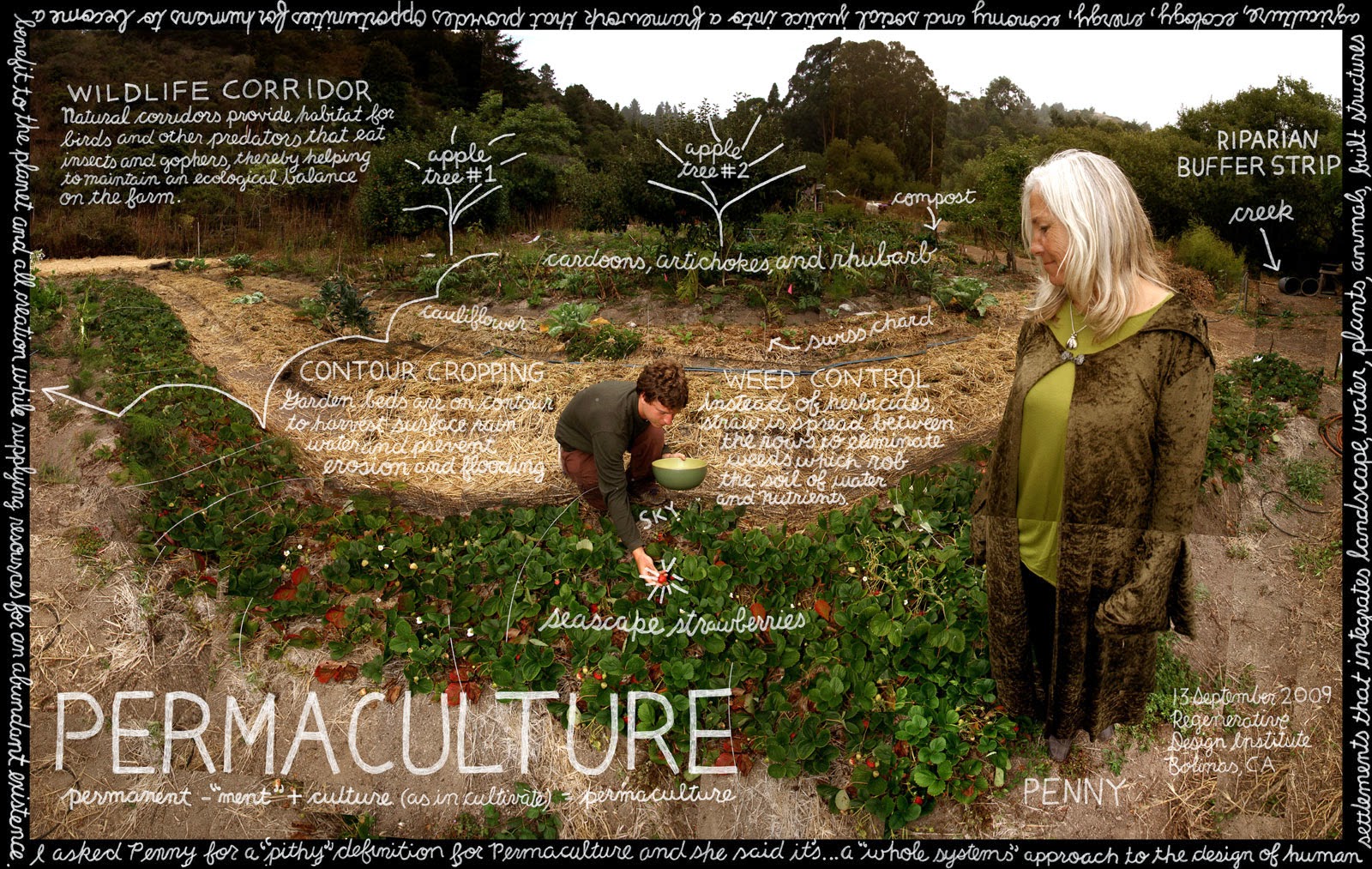
In the video "Permaculture, a Quiet Revolution" we are taken on a journey to the 8th International Permaculture Convergence in Brazil, where over 200 permaculture design course graduates and their mentors from over 43 countries have gathered to learn and to share their experience in order to prepare for and mitigate the looming global crisis. Their goal, to create sustainability now through self reliance. The only way this goal succeeds is if we all join the (r)evolution and share the message with as many people as possible as often as possible. I hope that you will be inspired and that you will catch the permaculture bug and spread it wherever you go.

Live light! 

Sunday, March 16, 2014

For further reading and a helping of Link Soup


Sorry I missed you all yesterday. I was doing the final run through on my presentation and packing up all the things for the farmers' market. The market was a huge success and we even had a few people turn out for my talk on permaculture. Thanks to all those of you who were there. I'm just back from the talk and as promised I'm putting up my suggestions for further reading and links. Since I had already scheduled a serving of Link Soup for the post for this weekend I will append those additional links along with this and that should all come together quite nicely. Just the thing for relaxing in the easy chair with on a blustery Sunday afternoon. 


So here you go:

Suggestions for further reading:
–            Permaculture: Principles and Pathways beyond Sustainability – David Holmgren
–            Introduction to Permaculture – Bill Mollison
–            Gaia’s Garden: A Guide to Home-Scale Permaculture – Toby Henenway
–            The Resilient Farm and Homestead – Ben Falk

I should also add (though not strictly permaculture books): Deep Economy by Bill McKibben and Radical Simplicity by Jim Merkel


Link Soup:
–             SeacoastPermaculture Meetup
–             Whatifwechange.org
–             350.0rg
–             Sustainableme.me
–             One Earth (R)evolution (You are here)
-             Appropedia
-             Zones and Sectors Efficient Energy Planning

I'm updating this post to add  this great link that Hubby sent me. It gets you thinking.
-             What are we putting in our bodies?

So there you have them folks. Enjoy and I hope to see you all at a permablitz real soon. 

Saturday, March 1, 2014

Saving the Soul of the Earth

The magical work of artist Bruno Torfs is featured in the film. Please visit his website. 

Today I would like to share with you  a great independent film "Anima Mundi; peak oil, climate change, permaculture and Gaia theory."  "Anima Mundi" is an artistic, spiritual and hard hitting look at the current state of the spirit of the world and an introductory instruction manual for saving the soul of the Earth. 

Please watch this movie, please listen to the lesson and please, please, share this post with as many people as you can. We need to wake up. I speak to myself as well as to all of you. Americans especially need to wake up and realize that we can not go on using resources at our current levels. The message that we need to share is that we can live completely full, happy and satisfied lives without destroying the world (and we are destroying the world). In fact we can live much happier lives with fewer things. We need to stop listening to the voices in the system that tell us that happiness is found in more and more things. We need to start listening to the voices that remind us that we had a story before cheap energy permitted the growth of our current bloated consumer economy. It was a story that was full of imagination, that created some of the greatest art, and the greatest minds, knowledge and logic the world has known. A story that was peopled with families who lived full, contented lives that did not destroy their environment.  

The fact of the matter is that we cannot continue to live a good life if we do not make changes now. This isn't the first time in human history that we have tapped out our resource base leading to desertification, massive human migration and wars of conquest. The fertile crescent was after all once a fertile region filled with cities and farms until the combination of human activity and climate changed tipped it over the edge turning it into a desolate moonscape incapable of supporting human life.  Today there are probably more than 10 times as many people on the planet as there were then and we have already expanded into all the habitable regions of the world. The world is already tipping into the area of peak resources. Not just peak oil, but gold, copper, silver and other ores and resources. As these resources become more scarce we are going to have to learn how to utilize the resources that we have already mined by much higher levels of recycling. But we will not solve the problem of peak resources just by recycling. We are also going to have to reduce our overall demand on Earth's resources. If you agree, please join the (r)evolution. 

Thursday, February 20, 2014

Variations on a Theme and The No Waste Home

Thanks to: http://www.newphilaoh.com/html/recycling_program.htm
Waste is an excess output of a system which has not been put to beneficial use. When waste reaches extreme levels it becomes pollution. Let's look at one scenario. If you have 2 acres and you have a cow or two, those cows will produce manure adequate to fertilize the soil. Now if you put 20 cows on those same two acres you are going to have way more manure than you will use as fertilizer. The manure will pile up and rot and create methane gas and when it rains the water that runs off  your property and into the nearest stream can lead to excessive algae growth and low oxygen conditions in the water. This same principle of waste becoming pollution applies to far more than just manure. 

Permaculture attempts to design integrated systems in which the output of one element of the system becomes the input of another element ultimately creating closed loops which feedback on themselves and generate no waste. The goal of eliminating waste from our systems is one of the primary goals of the One Earth Revolution. With this in mind I would like to suggest that you have a look at the blog of a family who have been living the no waste life in spades. They've done it and they are doing a great job sharing the message, so there is no need for me to reinvent the wheel. I'm just going to share their link here. 

Enjoy. I hope it will inspire you to embark on a no waste adventure of your own. Whether it be your home, your office, your home school group or girl or boy scout troop. No attempt is too small and certainly none is too large. Your church, your school, your neighborhood, your village....... Take it as far as you like, as far as you can. 

Sunday, February 9, 2014

One Man's Journey - Ben Falk TEDx Talk


Ben Falk's journey to a sustainable life takes an all too familiar route from growing up in the suburbs to some eye opening experiences in college and finally to a small farm in Vermont  were he is learning and teaching the use of  permaculture principles in creating a sustainable ecosystem on his 10 acre hillside lot. 

Ben's TEDx Talk takes you through those experiences and shares some of those eye openers. They are the reasons that we need to get in front of the movement for change and really start making some decisions in our daily lives that can have a positive impact on where things are going. It's not enough to just recycle a few things. It's not enough to car pool once or twice a week or take public transportation instead of driving. We need a radical cultural shift in the way we live and consume.

Please listen to Ben's talk and really let yourself hear the message. Don't take a jaded view or simply look away when he shows you pictures of the devastation wrought by factory farming and livestock feedlots. When you see pictures of tanks in the desert and when he talks about the desertification of the fertile crescent stop, really stop and think about what you are putting on your table. Think about your daily activities and about the things you buy. Think about the energy and resource demands that you as an individual make on the planet. I think many of us who are trying to be more environmentally conscious think "well at least I'm not as bad as that one. He's driving a huge SUV and lives in a 3000 square foot house." Well that may be true, but I would have to guess that the greater number of us could be doing way more than we are to make this a more just, healthy and equitable planet to live on. 

Wednesday, February 5, 2014

On God and Oil

The eye with which you see God, is the same eye with which God sees  you. (Adapted from M.  Eckhart)
I started out on this journey by saying that we need a revolution in ecology, economy, community and faith. I've touched a good deal in this blog on the ecology and the economy part. I've scratched the surface when it comes to community, but I don't think I've even skimmed it when it comes to faith. That has to change because this is a major area of concern in our current spiritual world climate where people are killing each other over questions of faith or using faith as an excuse for subjugating, disenfranchising or discriminating against others.  

While it is not my intention to offend anyone,  I have to speak to my convictions and my beliefs. I'm just going to lay this out there the way I see it. Everyone is free to make of it what they will and take from it what they will. So here it is folks. We need to wake up and realize that we are all like blind men fighting over the appearance of an elephant. Each one "sees" what he believes to be the whole, but his perception is limited and he does not see all. A comparative study of major religions will find that, on the key points and principles, there are more similarities than there are differences. While one group worships many gods, they see that these gods are all aspects of one God. While another group sees God as one, they recognize his roll as protector, redeemer, one who sustains you through your trials, avenger of wrongs, guiding light.....etc. and so on.  And we take it further, to the point where those who believe in one God must fight with each other because they disagree on how he should be worshiped. Have we completely missed the point of the message? When you boil it all down, isn't the message of all faiths that we should love God and love our neighbor as ourselves?  If  you truly believe that, how can you degrade, subjugate, disenfranchise, discriminate against and God forbid... harm or kill your neighbor? 

The truth is that while we hear that people are killing one another over their faith, this is only partially true. They are killing each other over power and access to power and much if not all of that is driven by wealth or access to wealth which in turn is driven by our oil saturated economy. This oil saturated economy is a global phenomena, so I feel justified in using "our". Demand for oil's outputs (fuel, fertilizer, plastics, clothing, food.....it seems like everything we touch these days is tainted with oil) may be highest in developed countries, but the negative impacts of this oil greedy culture are felt the most in the oil producing developing nations.

How many beauty pageant contestants and essayist have dreamed of "world peace". If so many people really want world peace why haven't we achieved it yet? Because we are putting the cart before the horse. Because we are treating the symptom rather than the disease. We have rampant poverty, social stratification and wealth disparity, between the first and third world and within each of these. We are not going to have peace while a minority of people grab power for themselves and step on the necks of everyone who gets in their way. We are not going to have peace while we continue to fight over an ever dwindling pool of resources. We are not going to have peace while some of us continue to take more than our fair share. 

So what can we do about it? We need to STOP and reassess our personal consumption habits. we need to do a true needs assessment and learn to live within our means, and I don't just mean within your personal household budgets. I mean we need to realize that on this finite planet there is a finite amount of everything that must be shared among all of us, and we need to look at what we are consuming and ask ourselves if it is really needed and if we are taking more than our share from the resources which belong to ALL of earth's creatures, not just to the ones with the biggest bank accounts and the most guns. We need to wake up to the fact that everything in our daily lives is saturated in fossil fuels, particularly oil, and we need to start looking for alternatives. It might help to stop and remember that we have been exploiting oil in the current fashion only for a little more than a hundred years. For the ten thousand years of recorded human history before that we survived and even thrived at times without it. And we need to remember that we will have to do so again, in a future that is far less distant than many of us think. Let's revive some of the tried and true method of human survival and invent some new less energy intensive methods to see us through the next ten thousand years.

Walk lightly, live lightly, shine brightly!

Saturday, February 1, 2014

First Earth - Earth First

Greetings all. Sorry I missed you on Wednesday. But as revolutions can not be stopped by the flu, we are coming to you today from the couch. Very grateful for Hubby who has kept me supplied with plenty of fluids to help keep me hydrated and get me on the mend that much quicker. It is such a blessing to have a warm comfortable home in which to recouperate. There are many people in the world who do not have that. In addition to my warm comfortable home I am fortunate enough to be able to afford this computer on which I communicate with you and the electricity and internet connection with which to operate it. I am truly blessed.

Thinking about how blessed I am makes me think of the many people in the world who are not, and the future generations who certainly will not be blessed if we don't rein in our rampant resource destruction and develop gentler more sustainable methods of living on this planet. 

The embedded video. "First Earth" takes you on a journey around the world to meet people who are learning and teaching such methods. It also delves in the the very deep, personal and spiritual reasons for the importance of adopting natural building practices. In the interest of blogging etiquette, I will warn you that one person drops the f-bomb early on, but other than that I don't recall any explicit language. 

I hope you will enjoy and be impressed and inspired.

Saturday, January 25, 2014

It's Time for a New Economy


So I have been thinking for some time now about doing a post on alternative exchange methods and a "New Economy." I  started to write something up about the need to return to more traditional methods of exchange. I'd even purchased a URL and taken other steps in order to start setting up Hour Exchange of the Berwicks.  In light of the recent data breaches at Target and Neiman Marcus, the constant fear of identity theft and concerns over financial insecurity, the time for this article seemed more than ripe. And then I saw this graphic! It bares a startling resemblance to my own list. Which got me thinking the time must be even more ripe than I thought. So.... here it is....


Source - https://www.facebook.com/foodisfree

Let's take it from the top:

Grow your own food or support a local CSA. Growing your own food is a great way to reduce food cost and increase the healthiness of  your diet. It is also one more way of bringing the production of our needs closer to home and increasing our security and sustainability in an uncertain world.


Make it yourself. If we make it ourselves, be it clothing or food or whatever, we have taken a big step toward local sourcing. Local sourcing helps to balance costs, prices and wages and reduces the impacts of production and distribution on the environment. Making things ourselves from local materials and ingredients also helps to build the LOCAL economy.  There are those who will use the argument that you shouldn't stop buying clothes from Bangladesh or coffee from Africa (etc and so on), because after all the countries that export those goods depend on selling to you for their economy. This is a justification on the part of the corporations who make their money on importing these goods at cut rate prices and selling them at huge mark ups. One of the first ways that we can help improve income equality and fair distribution of wealth is to advocate for higher wages for people who work in these factories. And one way to do that is to refuse to buy the products until the workers are paid a fare wage. 

Swap it! Borrowing and sharing really go together. How many of us have tools and other things that we use only very rarely? How many of us buy something because we need it today and we might only need it once or twice a year and perhaps not even that often. If we will share those things, we could reduce the demand for them. (Now watch how this dominoes.)  Neighbors begin sharing shovels and snow blowers and other tools. Fewer shovels and snow blowers and other tools are needed, fewer are produced. Environmental impact decreases. More people are sharing. They purchase fewer things. They need less space. They move to smaller homes. They need less money.  They work fewer hours or work from home. They commute less, the environmental impact decreases and decreases again.... and so on.  

Exchanging time for time (hour for hour) is one way of reducing income inequality and working toward a new economy.  Isn't it true that all of us are equally valuable and that all of our labor is equally valuable? But the monetary system that we have established leads people to feel that their worth is based on their income. Hogwash! Exchanging time for time allows us all to be on a level playing field, builds confidence and self worth, and eliminates roadblocks to success and improvement.

Reduce, Reuse, Repair, and Recycle I've already covered these here and here, and I will reiterate here that one of the primary and most important of these is reduce. Reduce, Simplify, Right-Size, work toward sustainability. 

What it all boils down to though is that we all need to learn a little something from the folks who have learned to do with less and not just 'make do' but live abundantly and be truly happy, happier perhaps than many of those who think they can only be happy if they have wealth, possessions and power.

Remember life is not in things but in experiences. So experience it and live light. 

Wednesday, January 15, 2014

CSA #3 and the Wonders of Refrigeration and Heating

Our latest CSA arrived on Friday and wonder of wonders there were blueberries! Thanks to the wonders of modern refrigeration, I was able to make these fabulous blueberry scones with real local Maine blueberries in the dead of winter. Do I wish that these blueberries were refrigerated using renewable energy? Yes I do. Does this make me want to advocate for my utility company to divest from fossil fuels? Yes it does. It also encourages me to research and advocate for more solar and other alternative energy sources that we and other local food producers can use on our own properties to make our farms more sustainable.  

This same feeling applies to the fresh local tomatoes which I purchased today from the local market to go on my veggie burger. I know that the tomatoes are local and were grown in a greenhouse not more than 50 miles from my home, but I don't know where the energy came from that heated the greenhouse. I don't think I'm going to stop buying my fresh locally greenhouse grown tomatoes in February (unless I find that they are very far from sustainable). But I do think it makes sense for us all to keep in mind the total inputs of energy that go into producing, transporting, marketing and storing our food. Armed with this information we can begin to make informed food choices. Making those informed choices is how we are going to make the changes that we need to make in order to heal this planet and keep it going for the next generation and the next.... and the next. 

It's getting late and I want to post this so....stay tuned for the scone recipe (special bonus post tomorrow).


Wednesday, December 18, 2013

Let's tackle those sustainability goals!

One of my primary sustainability goals is reducing my energy consumption. While we are in the process of transitioning from a fossil fuel dependent energy system to more sustainable methods of energy production it is important to limit our energy consumption as much as possible. By doing so we will both reduce the amount of greenhouse gasses being emitted and the demand for fossil fuels which drives much of the environmentally disastrous extraction of these fuels.

There are many ways that we can reduce our energy consumption from the novel to the mundane. Since it is December and everyone is obsessed with top 10's and top 100's, I'll give you 10 ways to reduce energy consumption. Not that there aren't a hundred ways, but I do have to get some sleep tonight. So here we go:

1. Declare an electricity free day. This might be best planned for early summer here in the chilly north east. You can cook outside, go without showering (take a dip in the nearest pond if you really need to get wet) and sit around the camp fire late into the night telling ghost stories or having a drum circle (or both), instead of sitting around inside surfing the net, watching TV or going to the Movies. 

2. Winterize your house! This is a step that I have just personally taken. There are several things to be considered here: Placing insulating gaskets behind  your outlet and switch plates, winterizing the windows (if you cannot afford replacement windows this is an affordable option that is more than worth the investment of time and money) and Increasing the insulation in your attic. This past weekend we spent 300 dollars on 26 bags of Green Fiber insulation. With this purchase we got the rental of the blower free for the day. It took us about 4 hours all together including set up  and cleanup. We doubled the heat retention in the upstairs and the investment will probably pay itself back in less than a year. 

3. Declare one screen free day each week. You will not only save energy, you will reduce your stress and you will have more time to spend on other interests that you never seem to have time for. 

4. Never use the "small load" setting on your washing machine. While it uses less water, it does not use significantly less electricity. Wait until you have a full load.

5. During warm months hang laundry outside to dry (or even in cold months if you are one of those die hard types that doesn't mind a little bit of chapped skin and a frozen nose...)

6.Switch to LED light bulbs. They are even more energy efficient than CFL bulbs and don't have the disposal issues related to the toxic chemicals.

7. Eat more raw foods. They are better for you anyway. Raw foods retain more nutrients and are generally higher in fiber and lower in fat and simple carbohydrates. You may find your waistline likes your new low energy diet as much as the planet does.

8. Install motion sensor switches on your home lights where appropriate. Lights will come on as you enter and will turn off after a period without motion. These lights are particularly well suited to common areas such as kitchen's and dining rooms where folks often pass through briefly and may forget to turn off lights. They may be less appropriate for family rooms and bedrooms (for obvious reasons).

9. Watch out for phantom energy suckers. Any appliance that has a light or clock on it is drawing energy even when not in use. Consider installing a power strip in an accessible place in your kitchen and plugging small appliances into it. Turn the power strip on when using the small appliances and turn them all off with the flip of one switch. After all, do you really need to have a clock on the stove, the microwave and the coffee maker. And how often do you really program the coffee maker to start automatically. We have an automatic coffee maker that we set perhaps twice a month. It takes 5 minutes to start coffee in the morning and how much energy do I save by not having the coffee pot drawing power the other 23 hours a day that I'm not using it? I can't tell you exactly, but I can tell you it is well worth the 5 minutes it takes to make the coffee.

10. Shower less often (I bet that wasn't what  you thought I was going to say). Honestly folks, Americans are way too obsessed with cleanliness. We've cleansed ourselves into the advent of super bugs and who knows what else in the way of obsessive compulsive behaviors.  If we showered or bathed only every second or third day and used the wash bowl in between, we would be just as clean and use far less water, electricity and heating oil.

That's all I have for you today. I could go on and on, but I hope that you will take these suggestions and add many more of your own. Have fun with it. Make it a competition with yourself to see just how much energy you can save.

Tuesday, December 17, 2013

Apologies for the brief Hiatus & A New Schedule

Greetings all. My apologies for the brief hiatus. I've been nursing a bad shoulder and not up for much sitting at the computer typing. While I've been keeping you in the dark, I've been busy winterizing, taking delivery of some delicious local produce, gathering new resources for this blog and for the website www.sustainableme.me and signing up for a permaculture design certificate course, among other things. I will have all the details for you in future posts. 

I'm keeping this one short. I just want to let you all know that I will be back in full swing with a regular post tomorrow. I Also wanted to give you my new  planned posting schedule.  I plan to have scheduled posts going forward in order to allow myself time to collect and prepare my materials and give you a really worth while post. This way you wont be getting blasted with update messages in your inbox every day for a week and then hearing nothing from me for 10 days. I'm all about right sizing our lives, and that includes the amount of time we spend in front of our computer screens. So I'm going to try to bring you plenty of worth-while information in a clear concise manner (interspersed with my own brand of dry Yankee humor) on a twice weekly schedule. I'll post on Wednesdays and Saturdays, and we'll see how that works. 

Until we meet again, I leave you with this quote by Yogi Bhajan  "Travel light, live light, share the light, be the light."

Tuesday, December 10, 2013

A Bit of Inspiration or My Top 10 for 2013

It's that time of year again. The comedians and the pundits and every periodical still published will be running their top 10 lists this month. There will be lists of the most over paid movie stars, the most popular songs and the hottest men. While they are all quite interesting I'm sure, I will leave them to the TMZ set. 

I give you here my top 10 Documentaries. There is inspiration and motivation a plenty in this list. So with out further adieu - The films!

Dirt the Movie "Inspired by William Brayant Logan's acclaimed book Dirt: The Ecstatic Skin of the Eart, Dir! The Movie takes a humorous and substantial look into the history and current state of the living organic matter that we come from and will later return to. Dirt! the Movie will make you want to get dirty." 


With One Voice " With One Voice brings together mystics from fourteen different spiritual traditions to share their perspectives on the unifying truth that transcends all religions." Honestly it is difficult for me to place this movie as number 2. I say they really both need to share the #1 spot. 

The rest of the list should be available or Netflix or by searching for the title in your favorite browser. 

Edens Lost and Found  This PBS series examines the prospects and potential for transforming depressed urban areas from economic junkyards into vital communities. Focusing on four major American cities, the film outlines the goals and rationale of sustainable development.

TEDTalks: Giving Adicts "Meet TED's super givers, who are championing the world's most daunting problems by showing what is possible when someone takes a stand. From Somalia to Mount Everest, from the Bronx to the North Pole, these amazing individuals share their stories."

Food Matters "With a staggering number of Americans suffering from obesity and other food-related maladies, this film takes a timely and hard-hitting look at how the food we eat is helping or hurting our health, and what we can do to live (and eat) better."

TEDTalks: Environment - Project Makeover  "Gas-guzzling addiction and our dying ecological lifeblood. Can we reverse the damage? These TED speakers are paving the road for sustainability. Here, they discuss a fungus-based packaging material, a new kind of recycling plant and much more."

I AM "In this reflective documentary, filmmaker Tom Shadyac chats with philosophers and spiritual leaders about what ails the world and how to improve it"

Happy Happy takes viewers on a journey from the swamps of Louisiana to the slums of Kolkata in search of what really makes people happy. Combining real-life stories and scientific interviews, the film explores the secrets behind our most valued emotion."

The Nature of Existence "Roger Nygard travels to the sources of the world's major philosophies and talks to everyone from physicist Leonard Susskind to Ultimate Christian Wrestling founder Rob Adonis to answer the questions, Why are we here and what are we supposed to do? Spiritual leaders, scholars, scientists, artists, pizza chefs and the guy next door inform this humorously enlightening documentary about the nature and meaning of life."

I hope you will enjoy and be inspired by these great films. I know that I was. 

Sunday, December 1, 2013

US Transition Movement

While doing research for another sustainability project that I am working on,  I came across some information on the Transition Town movement in the US. I have seen videos in the past on Transition Towns in the UK, but this is the first information I've found on the movement in the US. 

Here is an excerpt from the introduction to the Transition Primer:

Town Hall; Berwick, Maine
"Transition Initiatives make no claim to have all the answers, but by building on the wisdom of the past and unlocking the creative genius, skills and determination in our communities, the solutions can emerge.
Now is the time for us to take stock and to start re-creating our future in ways that are not based on cheap, plentiful and polluting oil but on localized food, renewable energy sources, resilient local economies and an enlivened sense of community well-being.
Local Transition Initiatives provide a process for relocalizing the essential elements that a community needs to sustain itself and thrive."

Because I agree wholeheartedly with these statements and with the concepts and precepts of the Transition Town movement I would like to share a couple of links here that you can refer to for more information on the movement. 

Transition US Home page can be found here.  And a primer for new groups can be found by following this link. I'm eager to put a pin on the map for an initiative in Berwick, Maine.  Let's all mobilize our communities!

Until next time, step lively.

Sunday, November 24, 2013

Just Enrolled in Maine Green Power

Just a quick post this morning. I just enrolled in Maine Green Power. 
It's one of those little steps. By supporting the development of local green power and reducing our own energy use, we are trying to do our bit to be part of the solution. Eventually I would like to take our place totally off grid. In fact I think that moving in the direction of a distributed grid system is the way we really need to go (more on this later.)